

Funeral costs can surpass $10,000, and funeral preplanning is one way to avoid financial strain on your loved ones. The median cost of a funeral with viewing and burial was $9,420 in 2021. Planning your funeral in advance will give your wishes the honor they deserve. It also relieves your family from making difficult decisions during grief. We’ve created this funeral pre planning guide to walk you through the steps and cover financial advantages along with common questions about pre-planning your funeral.

The first full week of May is National Pet Week which gives us a chance to reflect on our furry family members. They wait for us to get home and make the day brighter. Pets love us unconditionally and bring comfort in even the most trying of times. Our pets feel what we feel and have their own range of emotions as well. It’s important to remember pets can grieve when they lose someone that they are close to. There are many different pets that we love and share our homes with such as rabbits, guinea pigs, cats, and of course dogs. This week is a reminder to take care of our furry companions and make sure their needs are met. May 2- 8th is not only National Pet Week but also Dog Anxiety Awareness Week. May 8th is National Dog Mom’s Day and May 9th is National Animal Disaster Preparedness Day. Cat enthusiasts will appreciate June 4th is Hug Your Cat Day and June 24th as Cat World Domination Day. We also want to take the time to inform you about ways to help your pets during the loss of their beloved owner. Pets benefit from spending as much time as possible with their loved ones before they pass. Pets are very attuned to what is happening with our bodies and this will help them start the grief process. Pets benefit from having an item that belonged to their loved one with their scent on it after they pass. At Bradbury Memorial Center we include the pet family members when their human passes away and provide a pet grief gift. There are also many resources out there to help us when we lose our furry family members. In our local area, the WAHS (Wester Arizona Humane Society) holds a support group meeting. The meeting is on the second Monday of every month at 2 pm. The meeting is free but limited, so RSVP to Beth Pohl 928-854-4200 or Pastor Sandy Johnson 928-855-0323.
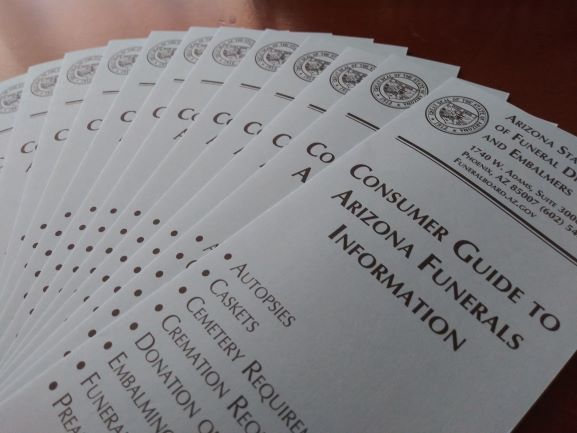
The Funeral Rule and The Consumer Guide What is ‘The Funeral Rule’? The Funeral Rule affects all funeral providers and is enforced by the Federal Trade Commission. The Rule makes it possible for the consumer to choose only those goods and services they want or need and to pay only for those they select, whether they are deciding arrangements after a death occurs, or pre-planning in advance. The Rule allows consumers to compare prices among funeral homes and select funeral arrangements they want at the funeral provider of their choice. The Rule does not apply to third-party sellers, such as casket and monument dealers, or to the cemeteries that lack an on-site funeral home. The Rule requires funeral providers to give consumers accurate, itemized price information and various other disclosures about funeral goods and services. The Rule prohibits funeral providers from: Misrepresenting legal, crematory and cemetery requirements Embalming for a fee without permission Requiring the purchase of a casket for direct cremation Requiring consumers to buy certain funeral goods or services as a condition for furnishing other funeral goods or services, and Engaging in other deceptive or unfair practices. The Rule pertains to both pre-need and at-need scenarios. The Rule went into effect in 1984, pre-need arrangement contracts signed before that time are not subject to The Rule unless it has been updated after 1984. The Rule states the funeral provider cannot refuse to handle a casket or urn you bought online, at a local casket store, or somewhere else – or charge a fee to do it. Furthermore, the funeral home cannot require you to be there when the casket or urn is delivered to them. The Rule: The General Price List The General Price List enables consumers to more easily comparison shop and to purchase, on an itemized basis, only the goods and services of their choosing. It is the law – funeral providers must give the General Price List to anyone who asks, in person, about funeral goods, funeral services, or the prices of such. The funeral providers are required to provide accurate price information on the phone if requested to do so. Callers are not required to provide their name, address, or telephone number. Funeral providers, however, are not required to provide the General Price List to consumers who have telephoned or mailed for inquiry unless followed up with an in-person meeting. Helpful hint: most funeral providers will email the General Price List and other pertinent information upon request. The Rule: Required Information on the General Price List Name, address; and telephone number of the funeral provider’s place of business(es); the caption ‘General Price List’; and the effective date of the pricelist. The Rule: There are six disclosures required on the General Price List: The consumer’s right to select only the goods and services desired. The law does not require embalming and may not be necessary in certain situations, such as direct burial or direct cremation. Helpful hint : Public viewings and airline transport are times when embalming is ideal or required. Alternative containers can be used for direct cremation, a casket is not required. Helpful hint: Not all providers include the alternative container in their package pricing. Helpful hint: A rigid, combustible container is required by law for cremation. The Basic Services Fee pertains to the fee for the professional services of the funeral director and staff. Helpful hint: The Basic Services Fee often is included in the provider’s package pricing. The Casket Price List price range and availability. Helpful hint: Despite the required notation on the General Price List, some providers have a separate, more detailed Casket Price List, selection list, or flip books, at the funeral home. The Outer Burial Container Price List Helpful hint: Funeral providers without a cemetery, and who do not sell these items, are therefore exempt from the required notation of the Outer Burial Container Price List on their General Price List disclosures. The Rule: The Statement of Funeral Goods and Services is an itemized list that the consumer has selected during the arrangements meeting. It includes detailed cost information. Helpful hint: The categories listed on the Statement of Funeral Goods and Services generally correspond to the items listed on the funeral provider’s General Price List. The Rule: Cash advance/cash disbursement/accommodation items may be listed separately on the Statement of Goods and Services as they are most often a third-party that is paid by the funeral provider on the consumer’s behalf. Helpful hint: These items include pallbearers, public transportation, clergy honoraria, flowers, musicians or singers, obituary publications, gratuities, death certificates, etc. For more information about the FTC Funeral Rule visit https://www.consumer.ftc.gov/articles/0300-ftc-funeral-rule For more information about “Shopping for Funeral Services” visit https://www.bulkorder.ftc.gov/system/files/publications/pdf-0056-funerals.pdf What is the ‘Consumer Guide to Arizona Funerals Information’? The Consumer Guide to Arizona Funerals Information brochure is a helpful collection of information designed to inform consumers about end-of-life arrangements. It is the law – funeral providers must give the “Consumer Guide to Arizona Funerals Information” brochure to consumers. The Consumer Guide is a quick overview and definitions for understanding autopsies, caskets, cemetery requirements, cremation requirements, body donation, embalming, funeral arrangements, and prearranged funeral plans. For more information about the Consumer Guide to Arizona Funerals Information visit https://funeralboard.az.gov/sites/default/files/documents/files/Consumer%20Guide.pdf

The death certificate provides pertinent identifying information about a deceased individual including their certified time, place, and cause of death. Most often, the death certificate serves as proof for legal purposes. These purposes range from estate settlement after death too if a widow wishes to remarry. It is the decedent’s assets that will determine the number of death certificates that will be needed . An average of 6 to 10 death certificates could be needed, with most emphasis on 10, according to web sources. At Bradbury Memorial Center, we simply pass along the state’s death certificate costs, which are $20/each. Typically, when a death record has been completed and filed, the death certificates can be ordered. On average, the death certificates can arrive within 6 to 10 days after ordering. However, in some counties, the process can take as long as a month. Notably, the death record/death certificate process overall can be delayed for cases pending autopsy results, toxicology results, or anything else required to determine an individual’s cause of death. A death certificate will be required to access a deceased person’s bank account. Unless you are the other person named on a joint account, it is illegal to withdraw money from an open bank account of someone who has died before the next of kin notifies the bank of the death and has been granted probate. This is the case even if there is a need to access the bank account to pay for the funeral or funeral home services. Accounts types that usually require a death certificate: Property/land transfers, or property tax payments Real estate (if it is held in survivorship, in a trust, or with a transfer-on-death designation) Vehicles such as cars, trucks, boats, motorhomes, etc. Anything else with titles or deeds Bank Accounts Safety deposit boxes Credit card accounts Death benefits from employers, pension programs, social security, etc. U.S. military veterans’ survivor benefits Insurance policies Life insurance Preneed insurance AD&D Insurance – Accidental Death and Dismemberment Insurance Home and automobile insurance Probate/Wills/Trusts Lawyers Stocks/Bonds Mutual funds ETFs – exchange-traded funds Savings bonds Annuities IRAs – Individual Retirement Account 401(k)s and employer death benefits The legalities involved: (According to Arizona Administrative Code R9-19-314 and R9-19-315) Arizona is a “closed record” state. This means vital records, such as the death certificate, are not public records . The confidentiality of citizens is protected under Arizona law and its restrictions on the public’s access to vital records. A person must be 18 years of age or older and an eligible recipient, to obtain a certified copy of a death certificate . A certified copy of a death certificate issued by Vital Records will have a raised seal, will show the signature of the local Registrar, and will be printed on security paper. Eligible recipients include a funeral director representing final disposition; next of kin including a surviving spouse, parent or grandparent, adult child, grandchild, or sibling; or another person deemed responsible for final disposition of the deceased; or a person with Power of Attorney for the decedent (granted the POA agreement specifies “through final disposition”). This also includes executors, beneficiaries, a person named in a court order, a person authorized by an eligible person, insurance companies or financial institutions, hospitals, healthcare institutions, a person with a court order having a claim against the deceased individual’s estate, an attorney representing an eligible person, a consulate or foreign government by request and government agency by request. Funeral directors responsible for the final disposition of the deceased person in question are eligible to order death certificates for one year following an individual’s death . In Arizona, eligible persons may order online directly from the Arizona Department of Health Services. In Mohave County, death certificates also may be ordered by eligible persons from the county’s Department of Public Health. Processing and postage fees do apply and are set by each of those entities. Please visit each of those department’s websites for further information.

The Hebrew word for mourning Ritually, the body of the deceased is washed thoroughly, dressed in a simple white linen shroud, or tachrichim, and prepared for burial in a simple pine, or sometimes redwood, coffin. Jewish custom requires burial to occur as close as possible to 24 hours. The deceased is carried to the graveyard amid a rabbi’s chants of biblical and liturgical verses. It is customary for the procession to stop along the way to allow mourners to express grief. Often, a eulogy is given either in a chapel or as the coffin is lowered into the grave. Then male mourners help fill the grave with earth. Traditionally, five stages of grief are observed to provide guidance during bereavement. First, it is the input. a Hebrew word meaning “deep sorrow”. It designates the time from death until burial. On that note, when despair is at its most intense, the mourner’s religious requirements come to a halt. The second is the three days following burial. It is a private time for weeping and expression of grief. The third is a period of seven days called shiva, it is when the mourner accepts the condolences of family and friends in the home and leads a prayer service. In contemporary times, shiva begins right after burial. Family and friends prepare meals so the mourner will not be distracted from their grief. Mourning generally concludes in the morning of the seventh day. Modern times has the second stage’s three days of private mourning coinciding with the third stage of sitting shiva. When it comes to the seven days of grieving, however, the Jewish may not mourn on the Shabbat or the Jewish Sabbath, nor may a burial take place on that day. The Shabbat does however count as one of the seven days. If a Jewish holiday occurs after the first day of shiva, the mourning period ends. The fourth stage is sheloshim when the mourner returns to work and normal social obligations. The final stage lasts 12 months during which the mourner returns to his or her customary functions. For example, the observant Jew says the kaddish, which is the prayer hymn for the dead, each week at the synagogue. The prayer has variations, according to web sources, but is noted as never mentioning death or dying. Instead, the prayer proclaims the greatness of God, and through recitation, the mourner affirms this greatness despite having their faith tested by loss. When mourning a parent, this can occur daily for 11 months post-burial. “May my death be an atonement for the sins, transgressions, and violations which I have sinned before you. And set my portion in the Garden of Eden and let me merit the World to Come reserved for the righteous. Hear O Israel the Lord our God, the Lord is One.” – Prayer on a deathbed, from a traditional Jewish Prayer Book Furthermore, the day of the dead is celebrated on the yahrzeit, or anniversary date. A memorial candle is lit in the home and burns all night. The gravesite, at a minimum, is visited during High Holy Days, or Yamim Noraim, or “Days of Awe” in the autumn months. It is the High Holy Days that encompass Rosh Hashana, or the Jewish New Year; and Yom Kippur, which is the “Day of Atonement”. The Jewish believe it to be the holiest day of the year. Both are among very special customs within Judaism. Gravesite etiquette among the Jewish includes visits on fast days and using the left hand to place a small stone of the grave even if the individual was unknown to the visitor in life. Leaving flowers is not a traditional Jewish practice. The placing and replacing of the stones are thought to perpetually ‘tend’ the grave’s existence. Visiting the gravesite is not reserved for specific days and can be visited at any time. With the Jewish year having approximately 354 days, Jewish festival days happen about the same time each year, but specific secular dates vary. In 2021, Rosh Hashana begins the evening of Monday, September 6, and ends the evening of Wednesday, September 8. This year’s observance of Yom Kippur begins Wednesday, September 15, and ends the evening of Thursday, September 16. The eight-day Hanukkah (Chanukah, Festival of Lights) is set to begin the evening of Sunday, November 28, and end Monday, Dec. 6, in 2021. The simple pine, or sometimes redwood, burial boxes are not created on the Jewish Sabbath (Shabbat), or on the seventh day of the week – beginning Friday evenings and ending Saturday night. The simple wooden coffin is about equality, to indicate that every human being is created equal and therefore every human being is equal in death. Organ donation is prohibited by general rule however permitted by means of a living will instruction. Jewish law, however, does not permit organ donation from a person in a living state. Judaism stresses burial on earth as a religious duty of laying someone to rest but some Jewish individuals do choose cremation as an acceptable disposition after death. Traditionally, nothing is buried in the casket with the deceased other than the linen shroud and earth. However, some families do ask to bury mementos like photos or letters within. Information based on various resources including both print and web sources.
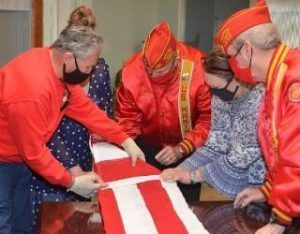
All photos courtesy of MCL Detachment #757 photographer Ron Silva, Lake Havasu City, Ariz. Bradbury Memorial Center staff is very grateful to have a handful of key members of the Lake Havasu Marine Corps League Detachment #757 teach us about the U.S. Flag in terms of folding it, handling it, respecting it, and presenting it. Local Marine Corps League Commandant Bud Watts, Captain of Color Guard/Honor Guard John Pulliam, ceremonies assistant Don Bittenbender, photographer Ron Silva, and Senior Vice Commandant Kim McCoy visited Bradbury Memorial Center in late January to help us learn more about the U.S. Flag. The honor of folding the U.S. Flag, how to create it, how to respectfully handle, hold it, and carry the Flag was told to us in vivid detail. With our co-owner Charles Marchand being a retired U.S. Navy veteran, the MCL members went above and beyond when explaining instructions to Charles so how he could appropriately present the U.S. Flag to the widow or family of a deceased U.S. military veteran here at Bradbury Memorial Center. Most recently, we do this when the funeral or memorial service of a deceased veteran is delayed for reasons of the current public health crisis. The Marine Corps League members also talked to us about the components of their full-scale U.S. Flag folding display when they are at either a graveside service or other funeral venue such as the park, a church, or a reception hall. We had many questions, which they graciously answered. On that note, they talked of their uniforms, shoes, gloves, roles, and more. They did this while demonstrating their protocol, positions, and commands that choreograph their reverent display during the ceremony. The Marine Corps League Color Guard Color Guard/Honor Guard went dark the latter part of 2020 during the pandemic however Bittenbender said they all hope to return to their full ceremonial duties in March. The group toured Bradbury Memorial Center during their visit and asked many good and very interesting questions about our building and our business and our industry. From all of us here at Bradbury Memorial Center, THANK YOU! Thank you for sharing your knowledge about U.S. Flag folding and protocol with us. And, most sincerely, thank you for your military service, we appreciate you!

Weeping Buddha statues depict Buddha in a bent-over position, crying, and covering his face. There is a legend of two masked warriors who fought each other in many battles. Neither defeating the other until one day when the older warrior killed the younger warrior. When the older warrior removed the opponent’s mask, he was confronted with the face of his only son. Seeing this, the older warrior – who is none other than the Weeping Buddha – began to cry. The torment and misery of having fought and killed his own son forced him to the ground where he cried tears of great anguish as he buried his face in his hands to hide from the truth of what he had done. It was then he renounced violence and proclaimed the virtues of helping the young, the sick, the suffering, and the old. It is believed that the Weeping Buddha is crying for the suffering of the World, he internalizes the grief and troubles of the World. In return, he bestows peace and provides strength and joy to those who rub his back.
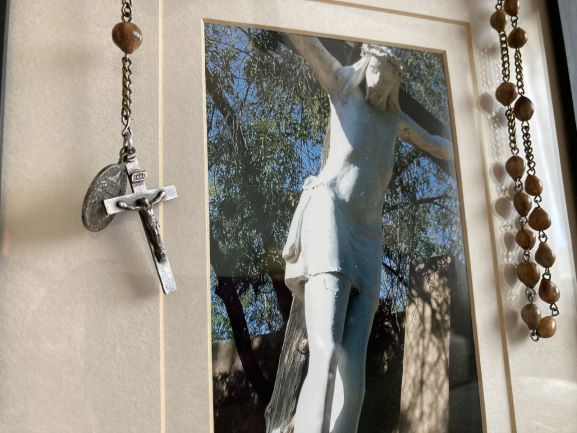
Photo courtesy of Jayne Hanson/Garden of Gethsemane, Tucson, Arizona : Lifesize sculptures include that of Jesus of Nazareth at the Last Supper with his disciples, and Jesus on the Cross, among other sculptures worth seeing. The Artist’s story : As Felix Lucero faced death as he lay on a World War I battlefield, he reportedly proposed a deal with the Virgin Mary: “spare my life, and I’ll spend the rest of my days creating Christian artwork.” After 20 years of time, Lucero began that promised work. Homeless and living in a shanty beneath a bridge in Tucson, Arizona, in 1938, his sculptures made their way into existence. Using damp sand reinforced with debris recovered from the Santa Cruz riverbed, he manifested his sculptures with plaster. His collection, called “Garden of Gethsemane”, has suffered the ravages of time, floods, and acts of vandalism. Lucero died in 1951 but his sculptures live on. Despite being moved several times to different locations, and repaired numerous times after vandalism, they now exist in a shady roadside park at 602 W. Congress Street, in Tucson. Admission is free. CATHOLICISM AND CREMATION Catholics do choose cremation as an end-of-life disposition, but their faith has them bound to a specific way of doing things. The three elements they observe, according to the Order of Christian Funerals, include the vigil or wake, the funeral liturgy, and the rite of committal. PART 1 – THE VIGIL The first part is the vigil, or wake; it is the principal rite celebrated in the time after death but before the rite of committal. This segment of time is an opportunity to pray for the soul of the deceased and is often an occasion for family and friends to express their memories of the deceased. When choosing cremation, it is always recommended the body be present for the vigil. PART 2 – THE FUNERAL LITURGY The second part is the funeral liturgy; it is the central celebration of the Christian community when it comes to the deceased. It is when the community gathers alongside family and friends to give praise and thanks. Catholics believe it is “through the Holy Spirit the community is joined together in sign and symbol, word and gesture that each believer through baptism shares in Christ’s death and resurrection and can look to the day when all the elects will be raised up and united in the kingdom on light and peace.”- Order of Christian Funerals #129 When choosing cremation, the Church encourages that the body of the deceased be present for the funeral rites. This is ideal for appropriate reverence for the sacredness of the body; the sprinkling with holy water, the placing of the pass and honoring the body of the deceased with incense. A casket may be rented for presentation of the body at the funeral. PART 3 – THE RITE OF COMMITTAL The Right of Committal is the conclusion of the funeral rites and therefore the final act of the community of faith in the caring for the body of a deceased member. This may be celebrated graveside, or at the tomb or crematorium. “In committing the body to its resting place, the community expresses the hope that, with all those who have gone before marked the sign of faith, the deceased awaits community of believers into welcoming company of those who need faith no longer but see God face to face.” – Order of Christian Funerals #206 When choosing cremation, the Church clearly prefers the body of the deceased to be present for the funeral rites. It is recommended the cremation take place after the Funeral Liturgy. REVERENT DISPOSITION OF CREMAINS “The best way to explain to people is simply to say: ‘ the cremains are shown the same respect as the body. If you wouldn’t split the body up or spread it around, then neither do we do that to the ashes ’,” stated Father Chauncey, Our Lady of the Lake Roman Catholic Parish, in a letter he recently penned to Bradbury Memorial Center. “The cremated remains should be treated with the same respect given to the human body from they come. This includes the use of a worthy vessel to contain the ashes, the way they are carried, the care and attention to appropriate placement and transport, and the final disposition,” – Order of Christian Funerals #417 “The cremated remains should be buried in a grave or entombed in a mausoleum of columbarium,” – Order of Christian Funerals #417 “The principal of respect for cremated remains of a deceased Christian embraces the deeper belief in the individuality of each baptized person before God. Throughout history, the mingling of remains has never been an accepted practice, except in extraordinary circumstances.” “The practice of scattering cremated cremains on the sea, from the air, or on the ground, or keeping cremated remains in the home of a relative or friend of the deceases are not the reverent disposition that the Church requires,” – Order of Christian Funerals #417 “Whenever possible, appropriate means for recording with dignity the memory of the deceased should be adopted, such as a plaque or stone which records the name of the deceased,” – Order of Christian Funerals #417 BURIAL IN A CATHOLIC CEMETERY Catholics are strongly encouraged to be buried or entombed in a Catholic Cemetery, where there is an assurance that the remains of the person will be treated with reverence and perpetual care. The Church recommends the burial or entombment of cremated remains occur without delay once the cremation process is completed. WHAT IS NOT PERMITTED BY THE CHURCH Use of a common grave, ground, or niche where the cremated remains of several persons are scattered, poured, buried, or combines without individual urns or sealed containers is to be completely avoided. BLESSING THE GRAVE OR NICHE A priest or deacon should accompany the remains to the cemetery and perform the prescribed liturgical rites. If the grave or niche has not been blessed, the priest of deacon is to do so at this time. THE BELIEFS “Since in baptism the body was marked with the seal of the Trinity and became the temple of the Holy Spirit, Christians respect and honor the bodies of the dead and the places where they rest,” – Order of Christian Funerals #19 “In the face of death, the Church confidently proclaims that God has created each person for eternal life and that Jesus, the Son of God, by his death and resurrection, has broken the chains of sin and death that bound humanity,” – Order of Christian Funerals #1

The current population of Earth is around 7.8 Billion. For most people, it is a large figure, that is all. However, someone has condensed the 7.8 billion in the world into 100 persons, and then into various percentage statistics. The resulting analysis is relatively much easier to comprehend. Out of 100 : (each section) 11 are in Europe 5 are in North America 9 are in South America 15 are in Africa 60 are in Asia 49 live in the countryside 51 live in cities 12 speak Chinese 5 speak Spanish 5 speak English 3 speak Arabic 3 speak Hindi 3 speak Bengali 3 speak Portuguese 2 speak Russian 2 speak Japanese 62 speak their own language. 77 have their own houses. 23 have no place to live. 21 are over-nourished 63 can eat full meals. 15 are under-nourished 1 ate the last meal but did not make it to the next meal. The daily cost of living for 48 is less than US$2 87 have clean drinking water 13 either lack clean drinking water or have access to a water source that is polluted 75 have mobile phones 25 do not 30 have internet access 70 do not have conditions to go online 7 received university education 93 did not attend college 83 can read 17 are illiterate 33 are Christians 22 are Muslims 14 are Hindus 7 are Buddhists 12 are other religions 12 have no religious beliefs. 26 live less than 14 years 66 died between 15 – 64 years of age 8 are over 65 years old If you have your own home, Eat full meals & drink clean water, Have a mobile phone, Can surf the internet, and have gone to college, You are in the minuscule privileged lot. (in the less than 7% category) Amongst 100 persons in the world, only 8 can live or exceed the age of 65 *If you are over 65 years old be content & grateful. Cherish life, grasp the moment. * You did not leave this world before the age of 64 years like the 92 persons who have gone before you. You are already blessed amongst mankind. Take good care of your own health because nobody cares more than you yourself! Cherish every remaining moment. Reprinted from Mohave County News – December 2020 Wrap-Up Edition, Published by Supervisor Buster Johnson, Volume 9. Issue 1.

Pet grief is something that can easily be overlooked in the chaos of a loss. Bradbury Memorial Center is very mindful of this and can help with pet grief by reminding our families who have pets that they, too, may need some extra love and care during the time of a loss. Especially companion animals who are very specific to a deceased loved one. Pet signs of grief Loss of appetite Lowered water intake Sluggish response to human or other pet interactions Loss of interest in play or physical activity An occasional mournful howl What to do Give extra love and affection Maintain a normal feeding schedule Stick to a regular exercise routine Increase playtime Be patient When it comes to cats, other web sources suggest simply talking to grieving cats or even regularly playing music for them helps ease their sadness. If a pet shows an increase of grief symptoms over many weeks or months, be sure to schedule a time for the pet to visit its veterinarian as soon as possible to rule out any physical illness the pet may be experiencing.